
Alcoholics Anonymous (AA) is one of the most widely used recovery frameworks in the world. Its foundation, the 12 steps , has helped millions of people overcome alcohol addiction since 1935. Each step is a deliberate action: not a rule imposed from outside, but a practice undertaken voluntarily, in sequence, with the support of a sponsor and a community of people who have walked the same path.
This guide covers every one of the 12 steps in depth, what each one says, what it actually means in practice, why it works psychologically, the common obstacles people face working through it, and how The Villa Treatment Center in Woodland Hills integrates 12-step principles into residential addiction treatment. If you are exploring AA for the first time, supporting someone in recovery, or looking to understand how the steps connect to professional treatment, this is the complete reference.
What Is Alcoholics Anonymous?
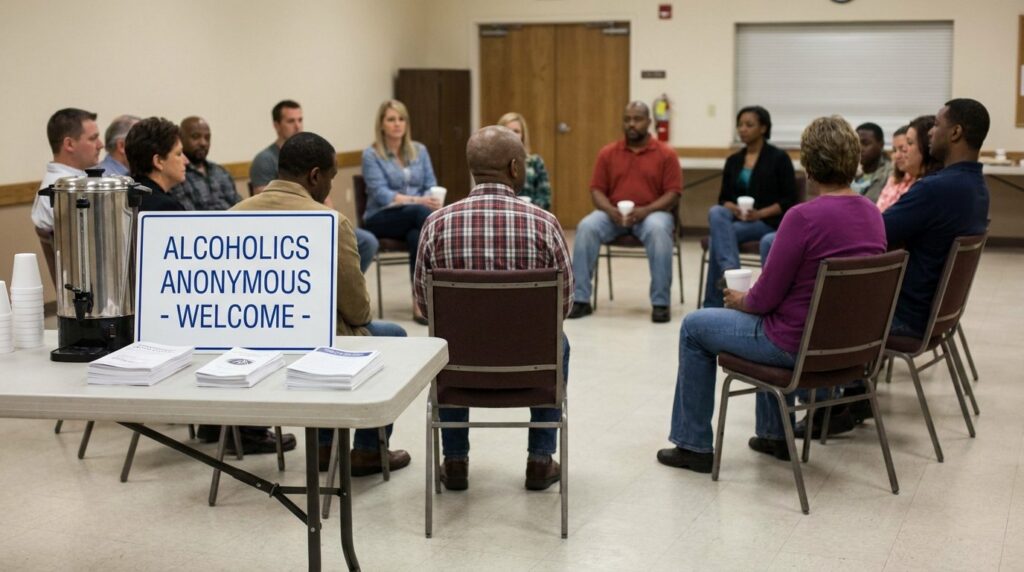
Alcoholics Anonymous was founded in 1935 by Bill Wilson and Dr. Bob Smith in Akron, Ohio. The two men, both struggling with alcoholism, discovered that talking honestly with another person who shared the same problem produced something that medical treatment alone had not: lasting sobriety. That discovery became the bedrock of AA.
Today AA operates in more than 180 countries, with over 120,000 groups worldwide and approximately 2 million members. It is free to join, has no dues or fees, and requires only one thing for membership: a desire to stop drinking. AA is not affiliated with any religion, political organization, or institution. It runs entirely through the voluntary participation of its members.
The 12 steps are not AA’s rulebook. They are a suggested program of action , a structured path that guides a person from active addiction toward what the program calls a spiritual awakening: a fundamental change in perspective that makes sustained sobriety not just possible but natural. The steps are worked in order, typically with a sponsor, a more experienced AA member who has completed them and guides the newcomer through the process.
At The Villa Treatment Center, the 12-step modality is woven into residential treatment programming. Clients engage with step work in group therapy, in one-on-one counseling through our individual therapy program, and in AA and NA meetings held both on-site and in the surrounding Woodland Hills community. The program is non-denominational, clients of all spiritual backgrounds, including those with no religious belief, work through the steps in a way that is meaningful to them personally.
How the 12 Steps Are Structured
The steps fall into three natural phases, each with a distinct psychological purpose:
- Steps 1, 3, Surrender and openness: Accepting the reality of the addiction, letting go of the illusion of control, and becoming willing to accept help from outside oneself
- Steps 4, 9, Self-examination and repair: Taking an honest inventory of behaviors and their consequences, disclosing them to another person, and making amends to those who were harmed
- Steps 10, 12, Maintenance and service: Daily practices that sustain the changes made in earlier steps, prevent relapse, and give back to others through service
Each phase builds directly on the one before it. A person who skips Steps 4 through 9 and jumps to Step 12 has not done the work that makes Step 12 meaningful. The sequence matters, which is why working the steps with a sponsor, rather than self-directing through them, significantly improves outcomes.
The 12 Steps of AA, Each One Explained in Full
Step 1, Admitting Powerlessness Over Alcohol
“We admitted we were powerless over alcohol, that our lives had become unmanageable.”
Step 1 is the hardest step and the most important one. It asks for something that goes against every defense mechanism addiction builds: complete honesty about loss of control. Not partial honesty. Not “I drink too much sometimes.” Full acknowledgment that alcohol has taken over, that willpower alone has not worked and will not work.
The word “powerless” is the one that stops most people. It sounds like defeat. In AA, powerlessness means something very specific: that once alcohol enters the body, the phenomenon of craving takes over and control is lost. It is not a character flaw. It is a description of how addiction functions neurologically. Admitting this is not weakness, it is the first act of genuine courage in recovery.
“Unmanageable” is the second key word. This refers to the wreckage that drinking has caused, damaged relationships, financial problems, health consequences, missed responsibilities, broken promises. A person working Step 1 is asked to look at this wreckage honestly rather than minimizing or explaining it away.
Common obstacle: Denial. Addiction is characterized by the brain’s extraordinary ability to convince the person that the problem is not as bad as it is, that they can control it if they really try, or that they are fundamentally different from “real” alcoholics. Breaking through denial is often what brings a person to Step 1, sometimes after a crisis, sometimes after a quiet moment of exhausted clarity.
Common myth: That a person must “hit rock bottom” before Step 1 can be worked. This is false. Rock bottom is wherever a person decides to stop digging. Many people work Step 1 successfully long before their life has completely fallen apart, and doing so prevents the destruction that comes with waiting.
Getting started with Step 1: Honest self-reflection on the evidence, times drinking was supposed to stop but didn’t, consequences that were accepted in order to keep drinking, promises made and broken, the gap between how much was intended to be drunk and how much actually was. A sponsor will often ask a newcomer to write these out before moving forward.
Step 2, Coming to Believe in a Power Greater Than Yourself
“Came to believe that a Power greater than ourselves could restore us to sanity.”
Step 2 introduces hope. After Step 1 establishes that self-reliance has failed, Step 2 asks: if I cannot do this alone, what can help? The answer is deliberately open-ended. A “Power greater than ourselves” is not defined. It does not require God, religion, or any specific spiritual tradition. For some people it means God. For others it means the collective wisdom of the AA group, nature, the universe, or simply the force of example provided by people who have stayed sober.
The word “sanity” is important here. AA’s literature describes insanity as doing the same thing repeatedly and expecting different results, continuing to drink despite overwhelming evidence that it destroys everything the person values. Step 2 asks a person to believe that this cycle can be broken with help from outside themselves.
Common obstacle: Atheism or agnosticism. Many people arrive at AA deeply skeptical of spiritual concepts, having had negative experiences with religion or simply having no framework for belief. AA’s response to this is consistent: the higher power only needs to be greater than you, not omniscient, not defined, not tied to any doctrine. The AA group itself qualifies. What matters is the willingness to believe that something beyond isolated individual willpower can restore stability.
What Step 2 is not: It is not a commitment to any religion. It is not a requirement to believe anything specific. It is an opening, a crack in the wall of self-sufficiency that allowed addiction to flourish. The willingness to even consider that help is possible is enough to begin.
Step 3, Making a Decision to Turn Your Will Over
“Made a decision to turn our will and our lives over to the care of God as we understood Him.”
Step 2 is about belief. Step 3 is about decision. The distinction matters enormously. A person can believe that a higher power exists and still choose to run their own life in ways that cause harm. Step 3 is the moment of choosing differently, deciding to stop relying solely on one’s own judgment and to align instead with something larger.
In practice, this step is about letting go of self-will run riot , the pattern of self-centered decision-making that drove the drinking. It does not mean becoming passive or surrendering personal agency. It means recognizing that the decisions made purely from self-will, using, hiding, manipulating, isolating, consistently made things worse, and being willing to make decisions differently.
Many people find Step 3 easier to work conceptually than practically. The decision can be made in a moment; the application of it takes a lifetime. This is why Steps 10, 11, and 12 later return to the same principles in a daily maintenance form.
Common obstacle: The fear of losing control. Ironically, the person addicted to alcohol has already lost control, to the substance. Surrendering self-will to a higher power is not a further loss of control but a recovery of it, because decisions made without the distortion of addiction are clearer and more effective.
The Step 3 prayer is often used as a daily anchor: “God, I offer myself to thee, to build with me and do with me as thou wilt. Relieve me of the bondage of self, that I may better do thy will. Take away my difficulties, that victory over them may bear witness to those I would help of thy Power, thy Love, and thy Way of life. May I do thy will always.” Non-religious members often use a modified version that speaks to whatever higher power is meaningful to them.
Step 4, Taking a Searching and Fearless Moral Inventory
“Made a searching and fearless moral inventory of ourselves.”
Step 4 is where the hard internal work begins. This step asks a person to write a thorough, honest account of their inner life, specifically: resentments, fears, sexual conduct, and the harms caused to others. The purpose is not self-punishment. It is self-knowledge. The goal is to identify the emotional and behavioral patterns that drove the drinking, because without understanding those patterns, they continue to drive behavior even in sobriety.
AA literature describes three primary areas the Step 4 inventory examines:
- Resentments: Who or what has been resented, what happened, how it affected the person’s sense of self, and, most importantly, what role the person played in creating or sustaining the situation. The inventory shifts the lens from “what they did to me” to “what part did I play.”
- Fears: What fears have governed decisions, fear of financial insecurity, fear of rejection, fear of being seen as inadequate, fear of intimacy. Fears that were managed through drinking rather than addressed directly.
- Harms to others: Where selfishness, dishonesty, or carelessness caused harm to other people, in relationships, in professional life, in family.
The inventory is written, not just thought through. Writing forces specificity. A vague sense of guilt is different from a written account of what actually happened and what the person’s part in it was.
Common obstacle: Perfectionism and avoidance. Many people stall on Step 4 because they are waiting to feel ready, or because beginning the inventory feels overwhelming. Sponsors often address this by suggesting the person simply start writing, any resentment, even a small one, and the momentum builds from there. The inventory does not need to be perfect. It needs to be honest.
What happens after: The written inventory becomes the foundation for Steps 5 through 9, it is the raw material for disclosure, for releasing shame, and for making amends. It is not written and then discarded. It is written to be shared.
Step 5, Admitting the Exact Nature of Our Wrongs
“Admitted to God, to ourselves, and to another human being the exact nature of our wrongs.”
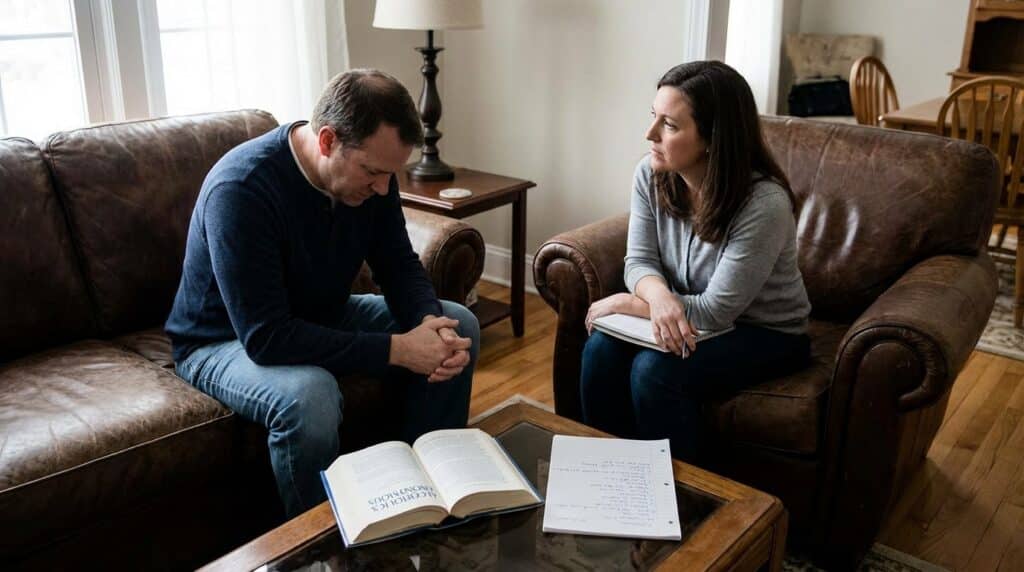
Step 5 takes everything written in Step 4 and speaks it aloud to another person. This is typically a sponsor, but can be a therapist, a clergy member, or any trusted person capable of listening without judgment. The step has three movements: admitting to a higher power, admitting to oneself, and admitting to another human being. All three are necessary. None alone is sufficient.
The reason a second person is required is psychological and practical. Secrets lose their power when shared. Shame, which thrives in isolation, weakens dramatically when it is witnessed by another person who does not recoil. The act of saying the thing out loud, the specific behavior, the specific harm, the specific fear, and having it received without condemnation is one of the most therapeutically powerful experiences in recovery.
AA’s literature notes that most people experience profound relief after completing Step 5. The weight of carrying secrets, sometimes secrets held for decades, is lifted. Many describe it as the step where they first felt genuinely clean, not just abstinent.
Common obstacle: Shame and fear of judgment. The fear that sharing certain information will cause the other person to recoil, reject, or condemn. A good sponsor will have heard comparable or worse from others and will meet the disclosure with understanding rather than judgment. The experience of being received without condemnation is itself part of the healing.
What “exact nature” means: Not just what happened, but the character defect underneath it. Not just “I lied to my wife about money” but “I was dishonest and self-seeking.” The inventory and the admission are meant to reveal patterns, not just events.
Step 6, Becoming Entirely Ready to Have Defects Removed
“Were entirely ready to have God remove all these defects of character.”
Step 6 is often called the most overlooked step because it asks for something subtle: willingness, not action. The defects of character identified in Steps 4 and 5, dishonesty, self-centeredness, fear-driven behavior, resentment, pride, are not removed in Step 6. The person only becomes ready for them to be removed.
This distinction matters because many people in early recovery are not, in fact, ready to let go of all their character defects. Some of those defects have been protective, dishonesty may have kept someone safe in a chaotic home, self-centeredness may have been the only way to survive. Acknowledging that willingness to let go is incomplete is itself progress. Step 6 does not demand perfection. It asks for honesty about readiness.
The character defects most commonly surfaced in Step 4 and addressed in Step 6 include: pride, greed, lust, anger, gluttony, envy, and sloth, but in their specific, personal form. Not abstract vices but the actual patterns of behavior that caused harm and that drinking was used to manage or suppress.
Common obstacle: Attachment to defects that still feel useful. A person who has used dishonesty to manage conflict for 20 years may be intellectually willing to let it go while emotionally still clinging to it. Step 6 works best when the person can sit honestly with this ambivalence rather than performing readiness they do not feel.
Step 7, Humbly Asking for Shortcomings to Be Removed
“Humbly asked Him to remove our shortcomings.”
Where Step 6 is preparation, Step 7 is the request, a conscious, humble act of asking for help with what the person cannot change alone. The key word is humbly. AA defines humility not as self-deprecation but as an accurate understanding of one’s place, neither inflated with ego nor crushed by shame. Humility is the middle ground: knowing what you are capable of, acknowledging what you are not, and asking for help without demanding it on your terms.
For people whose addiction was driven by pride, perfectionism, the need to appear strong, or the terror of being seen as weak, this step represents a fundamental reorientation. It is the practical application of Step 3, turning will over to something greater, applied specifically to the character defects that have caused the most damage.
The Step 7 prayer: “My Creator, I am now willing that you should have all of me, good and bad. I pray that you now remove from me every single defect of character which stands in the way of my usefulness to you and my fellows. Grant me strength, as I go out from here, to do your bidding.” Again, non-religious members adapt this to fit their personal understanding of a higher power.
Important clarification: Steps 6 and 7 do not promise that character defects disappear instantly or permanently. They describe an ongoing process. A person who has been dishonest for 30 years will not become entirely honest after working Step 7. The steps create the conditions for change and the willingness to keep working toward it. The actual transformation happens gradually, over years of practice.
Step 8, Making a List of Those We Have Harmed
“Made a list of all persons we had harmed, and became willing to make amends to them all.”
Step 8 is the bridge between self-examination and repair. Using the inventory from Step 4, the person compiles a list of everyone harmed by their drinking and the behaviors that came with it, family members, romantic partners, employers, friends, financial creditors, people hurt in accidents, and sometimes oneself.
The list typically falls into three categories that sponsors use to organize the amends process in Step 9:
- Those to whom direct amends can be made immediately, people who are accessible, willing to receive the amends, and where contact will not cause further harm
- Those to whom amends must be delayed, people who are not yet ready to receive contact, or situations where more preparation is needed
- Those to whom direct amends cannot be made, people who have died, who cannot be located, or where direct contact would cause harm to a third party
The critical word in Step 8 is willing. The amends do not happen yet. The person only commits to becoming willing to make them. This is significant because some people on the list may be people the person is still angry with, people who also caused harm. The willingness to make amends regardless of what the other person did is part of what this step demands, and it often requires working through considerable resistance with a sponsor.
Common obstacle: The belief that an amends requires the other person’s forgiveness. It does not. An amends is about the person making it, not the person receiving it. Whether the other person forgives, rejects, or is indifferent does not change the value of making the amends.
Step 9, Making Direct Amends
“Made direct amends to such people wherever possible, except when to do so would injure them or others.”
Step 9 is where repair begins. The person makes direct contact, in person where possible, by letter when in-person contact is not appropriate, with the people on their Step 8 list and acknowledges the specific harm caused and what they are doing to address it. This is not an apology. An apology is verbal. An amends includes changed behavior.
The phrase “except when to do so would injure them or others” is the crucial qualifier. Not every amends can be made directly. Contacting an affair partner whose spouse is unaware of the affair could destroy a marriage and cause harm to innocent people. In those cases, the amends is made differently, sometimes through living amends (changed behavior over time), sometimes through charitable action, sometimes through other means determined with a sponsor.
AA’s 12 Steps and 12 Traditions identifies several categories of amends:
- Financial amends: Paying back money owed, even in small installments over time
- Personal amends: Acknowledging harm done to relationships and demonstrating changed behavior
- Living amends: For situations where direct contact is impossible or harmful, committing to behave differently going forward and proving it through action
- Posthumous amends: For people who have died, writing a letter, making a charitable donation in their name, or speaking the amends aloud in the presence of a sponsor
Common experience: Many people report that the amends they dreaded most, the ones they spent months avoiding, produced the most unexpected responses. People who were fully expected to be furious often expressed relief, forgiveness, or gratitude. The anticipation of the amends is almost always worse than the amends itself.
Common obstacle: The belief that making amends means revisiting and reopening painful situations unnecessarily. A well-made amends does not dwell on guilt or demand absolution. It acknowledges harm clearly and briefly, asks what can be done to make it right, and then moves forward. The goal is not emotional catharsis for the person making the amends, it is genuine repair.
Step 10, Continuing to Take Personal Inventory
“Continued to take personal inventory and when we were wrong promptly admitted it.”
Steps 10 through 12 are the maintenance steps, the ongoing daily practice that keeps recovery alive rather than allowing it to calcify into complacency. Step 10 is essentially Steps 4 and 5 compressed into a daily habit: at the end of each day (or in real time when something goes wrong), the person pauses to examine their behavior honestly and acknowledges any mistakes promptly.
The word “promptly” is the key. One of the most common patterns that precedes relapse is the slow accumulation of unaddressed resentments, small dishonest acts, and avoided accountability, the same patterns that fueled the drinking before recovery. Step 10 prevents this accumulation by keeping the ledger current. Nothing is allowed to build up.
In practice, a daily Step 10 might be as simple as asking: Did I owe anyone an apology today? Was I dishonest? Did I act from self-interest in a way that harmed someone? Was I resentful? Did I do the right thing even when it was difficult? These are not rhetorical questions, they are meant to produce specific, honest answers that inform action.
Three forms of Step 10:
- Spot check: A brief inventory done in the moment when something feels wrong, a flash of anger, an impulse toward dishonesty, a building resentment
- Daily review: An end-of-day inventory examining the full day’s behavior
- Periodic inventory: A longer, written inventory done periodically, monthly or quarterly, similar in depth to Step 4, but focused on recent patterns
Step 11, Prayer, Meditation, and Conscious Contact
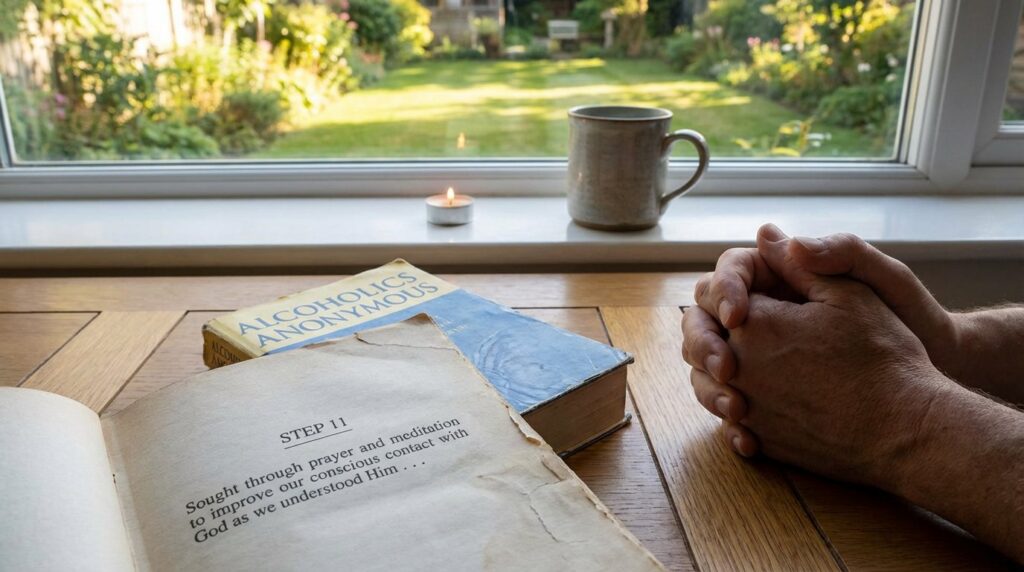
“Sought through prayer and meditation to improve our conscious contact with God as we understood Him, praying only for knowledge of His will for us and the power to carry that out.”
Step 11 establishes a daily spiritual practice. While Step 3 was the decision to align with something greater, Step 11 is the ongoing maintenance of that alignment through prayer and meditation. The purpose is not ritual, it is the cultivation of a stable inner orientation that makes it possible to act from values rather than from fear, craving, or impulse.
For members who do not pray in the traditional sense, Step 11 is often practiced through meditation, mindfulness, journaling, time in nature, or any reflective practice that creates space between stimulus and response. The goal is the same regardless of the form: a daily connection to something beyond the self that grounds the person in their recovery and their values.
AA literature is specific about what to pray for: “knowledge of His will and the power to carry it out.” Not for specific outcomes. Not for things or circumstances to be different. For clarity and strength to do what is right, regardless of what that turns out to be. This orientation, seeking direction rather than demanding results, is fundamentally different from the self-willed approach that characterized the addiction.
At The Villa Treatment Center, Step 11 is reflected in our holistic treatment offerings: mindfulness training, meditation sessions, yoga, and reflective practices are integrated into the residential program precisely because the research on their effectiveness in supporting emotional regulation and reducing relapse risk is strong. These are not optional extras, they are clinical tools.
Step 12, Carrying the Message and Practicing These Principles
“Having had a spiritual awakening as the result of these steps, we tried to carry this message to alcoholics, and to practice these principles in all our affairs.”
Step 12 completes the cycle and begins it again. By this point, the person has done the work, the painful honesty of Steps 1 through 9, the daily maintenance of Steps 10 and 11, and has experienced the result: a spiritual awakening. In AA, a spiritual awakening does not necessarily mean a dramatic religious experience. It means a fundamental change in how a person relates to themselves, to others, and to life. The obsession with drinking has lifted. The behaviors that were driven by addiction have changed. A different life has become possible.
Step 12 asks the person to do two things with this transformation. First, carry the message to others , share what happened with people who are still suffering. This is why AA meetings continue to function and grow: people who have found sobriety return not because they are required to but because helping others is what keeps them well. Service to others is simultaneously an act of generosity and a protection against relapse.
Second, practice these principles in all affairs , not just in AA meetings or in interactions with other alcoholics, but in every dimension of life. At work, in family, in community, in private moments when no one is watching. The 12 steps are not a one-time program. They are a way of living.
What a spiritual awakening actually looks like: For most people it is gradual rather than sudden. They notice, after months or years of practicing the steps, that they respond to difficult situations differently, with more patience, more honesty, less reactivity. That resentments do not linger the way they once did. That they can experience discomfort without reaching for something to numb it. That they genuinely want to help people rather than merely appearing to. This is the awakening: not a vision or an ecstatic experience, but a quietly transformed life.
How The Villa Treatment Center Incorporates the 12-Step Modality
The Villa Treatment Center in Woodland Hills, CA is a Joint Commission accredited, DHCS licensed (License #190807BP) residential treatment facility. Our 12-step modality is designed to be inclusive, it serves clients of all spiritual backgrounds, including those with no religious beliefs, by focusing on the principles underlying the steps rather than requiring any specific tradition.
Our program integrates 12-step work at every level of care:
- Group therapy structured around step work, licensed counselors facilitate sessions that introduce and work through each step in a supported group environment, with accountability and shared experience at the center
- Individual therapy, one-on-one sessions through our individual therapy program in Woodland Hills allow clients to work through the more personal dimensions of each step, particularly Steps 4 through 9, in depth and privacy
- AA and NA meetings, clients attend meetings both at the facility and in the surrounding community, building the peer connections that sustain sobriety after discharge
- Family therapy, incorporating the principles of Steps 8 and 9, our family therapy program supports the repair of relationships damaged by addiction and helps family members understand the recovery process
- Dual diagnosis treatment, many clients who benefit from 12-step work also have co-occurring mental health conditions. Our dual diagnosis program treats both simultaneously, because untreated mental health conditions are among the most common drivers of relapse
- Holistic programming, mindfulness, meditation, yoga, and physical wellness practices that directly support the daily practice called for in Step 11, with research backing their effectiveness in emotional regulation and relapse prevention
- Aftercare and alumni programming, the 12-step work that begins in residential treatment is designed to continue after discharge. Our aftercare planning includes step-based community support, alumni programming, and outpatient referrals that keep the connection to recovery active
Is AA the Right Approach for You?
AA is not the only evidence-based approach to recovery from alcohol use disorder, and it is not required for treatment at The Villa Treatment Center. Research consistently shows that 12-step facilitation is effective, particularly for people who engage fully with the program, but it is one approach among several, and the best approach is the one that fits the individual.
AA tends to work well for people who:
- Benefit from structured accountability and community, the program provides both, built in
- Are willing to engage with the process of self-examination, even when it is uncomfortable
- Want access to a free, lifelong support network available everywhere in the world
- Are open to the concept of a higher power, however broadly defined
- Struggle with isolation, AA’s community model directly addresses the loneliness that often both causes and results from addiction
If you are uncertain whether AA is the right fit, our admissions team can walk you through the different recovery frameworks we incorporate and help identify what will work best for your specific situation. Treatment is not one-size-fits-all, our job is to match the approach to the person, not the person to the approach.
Frequently Asked Questions About the 12 Steps of AA
Do I have to believe in God to work the 12 steps?
No. The language “God as we understood Him” means the concept of a higher power is entirely self-defined. People in AA have described their higher power as nature, the universe, the ocean, the AA group itself, music, or simply the collective wisdom of people in recovery. The Villa’s 12-step modality is explicitly non-denominational and welcomes clients of every spiritual orientation, including those with no religious beliefs. What matters is the willingness to accept that something beyond isolated self-will can help, and that something can be defined in any way that is genuine and meaningful to you.
How long does it take to complete the 12 steps?
There is no fixed timeline. Some people move through the steps in months; others take years on certain steps. Steps 10, 11, and 12 are never “completed”, they are ongoing daily practices that continue for the rest of a person’s life in recovery. During residential treatment at The Villa, clients begin engaging with Steps 1 through 3 in a structured, supported environment and lay the groundwork for the deeper work of Steps 4 through 9. This continues in aftercare, outpatient, alumni programming, and AA meetings after discharge.
What is the difference between AA and NA?
Narcotics Anonymous (NA) uses the same 12-step framework as AA but is designed for people struggling with drugs rather than specifically alcohol. The steps are nearly identical. Many people attend both AA and NA meetings depending on the nature of their addiction. The Villa offers access to both AA and NA meetings as part of our treatment programming, as well as Buddhist recovery meetings and other spiritually inclusive options for clients from non-12-step traditions.
Can I do 12-step work alongside professional therapy?
Yes, and this combination is supported by research. AA and professional clinical treatment are complementary, not competing. The steps provide community, structure, accountability, and a spiritual framework. Therapy provides clinical tools to address underlying trauma, mental health conditions, cognitive distortions, and behavioral patterns. At The Villa, both work together as part of a single integrated treatment plan. Clients who engage with both simultaneously typically show stronger outcomes than those who pursue either alone.
What is a sponsor and do I need one?
A sponsor is an experienced AA member who has completed the 12 steps and guides a newcomer through them. Sponsors are not therapists, they do not provide clinical treatment. Their value is experiential: they have been through the same process and can share what worked, what didn’t, and how to navigate the specific challenges of each step. Research consistently shows that working with a sponsor improves outcomes in 12-step programs. It is not mandatory, but it is strongly recommended.
What happens at an AA meeting?
AA meetings vary in format but most follow one of a few common structures: speaker meetings (one or more people share their story), discussion meetings (a topic related to the steps or recovery is discussed), Big Book or step study meetings (the group reads and discusses AA’s primary text). All meetings end with the Serenity Prayer. Meetings are free, open to anyone with a desire to stop drinking, and anonymous, what is shared in the room stays in the room. Most areas have multiple meeting types available in person and online.
What is the Big Book of AA?
The Big Book, formally titled “Alcoholics Anonymous”, is the primary text of the AA program. Published in 1939 and now in its fourth edition, it contains the 12 steps, the philosophy behind them, personal stories from early AA members, and detailed guidance for working each step. It is the foundational reference that sponsors use when guiding newcomers through the program. It is available free online at aa.org and at any AA meeting.
Does the 12-step program work?
Research on AA’s effectiveness consistently shows positive outcomes for people who engage fully with the program. A 2020 Cochrane review, the gold standard in medical research, found that AA was significantly more effective at achieving continuous abstinence than other interventions, and that its benefits persisted over time. AA is most effective for people who attend regularly, work with a sponsor, and engage with the steps rather than merely attending meetings passively. Like any treatment, engagement quality determines outcome quality.
What if I relapse while working the steps?
Relapse is common in addiction recovery, it is not a sign that the program has failed or that the person is beyond help. AA’s approach to relapse is to return to the steps without shame, examine what happened, and continue forward. Many of the most respected long-term members of AA have experienced relapse and found that working through it deepened their recovery rather than ending it. The Villa’s treatment and aftercare programming address relapse prevention explicitly, and our alumni team remains available to clients who need support after discharge.