
You’ll find that no single medication universally outperforms others for cocaine addiction treatment. Topiramate reduces cravings greatly, patients are eight times more likely to test cocaine-negative than placebo groups. Sustained-release dextroamphetamine tripled abstinence rates in trials. Propranolol effectively manages severe withdrawal symptoms with 69% treatment completion rates. Modafinil combined with therapy shows promise for those without alcohol dependence. Baclofen and tiagabine enhance outcomes through GABAergic mechanisms. Your ideal treatment depends on individual factors, comorbidities, and withdrawal severity, elements worth exploring further.
Dopamine Agonists and Amphetamine-Based Treatments

While dopamine agonists have long been theoretically attractive for cocaine addiction treatment, given cocaine’s mechanism of enhancing dopamine signaling, the clinical evidence doesn’t support their use. Systematic reviews and meta-analyses of 17 to 24 studies show no considerable benefit in reducing cocaine use or improving abstinence rates compared to placebo. Dopamine agonists like bromocriptine, pergolide, and l-dopa, carbidopa demonstrated insufficient effectiveness, with amantadine performing conspicuously worse than antidepressants. No current evidence supports the clinical use of most pharmacological treatments for cocaine dependence beyond specific interventions. The lack of proven pharmacological alternatives underscores the urgent need for advances in neurobiology to guide future medication development. FDA regulatory oversight ensures that any emerging treatments undergo rigorous structured benefit-risk assessment before clinical approval.
In contrast, sustained-release dextroamphetamine delivers substantial results. Clinical trials show cocaine use days dropped from 61 to 45, with continuous abstinence rates tripling compared to placebo. This amphetamine-based approach addresses dopamine dysfunction management more effectively, and treatment compliance challenges decrease dramatically, up to 89% of participants completed trials without serious adverse events.
Modafinil as a Cognitive Enhancement Option
Unlike dopamine agonists that’ve failed to demonstrate clinical benefit, modafinil offers a distinct pharmacological approach to cocaine addiction treatment through its mechanism as a weak dopamine transporter inhibitor. You’ll experience improved mood, energy, and concentration during recovery, reversing withdrawal-associated cognitive deficits that compromise your functioning. Clinical trials show you’ll report greatly reduced cocaine cravings and achieve higher abstinence rates when combining modafinil with cognitive-behavioral therapy. However, adherence challenges limit outcomes, your benefits correlate directly with treatment duration exceeding eight weeks. Remarkably, comorbid condition effects matter: participants without alcohol dependence demonstrate substantially better results, with abstinence rates reaching 23% versus 9% in placebo groups. Research conducted at University of Pennsylvania School of Medicine by leading addiction specialists has established the efficacy and safety parameters for modafinil treatment protocols. Modafinil’s excellent tolerability and safety profile make it a viable cognitive enhancement strategy supporting your long-term recovery success.
Topiramate for Craving Reduction

You’ll find that topiramate reduces cocaine craving by modulating GABAergic and glutamatergic neurotransmission, mechanisms that suppress dopamine release in reward pathways and directly target cocaine’s reinforcing effects. Clinical trials demonstrate topiramate’s superiority over placebo, patients receiving the medication are over 8 times more likely to test cocaine-negative and show markedly reduced weekly cocaine use compared to controls. When you combine topiramate with cognitive-behavioral therapy, you achieve enhanced abstinence outcomes, though integrating it into dual cocaine-alcohol dependence treatment requires careful monitoring and individualized dose titration between 200, 300 mg daily. The medication demonstrated favorable tolerability with mild and evenly distributed adverse events across treatment groups. Research indicates that topiramate’s non-addictive nature makes it a desirable alternative to agents with abuse liability for substance dependence management. However, a 12-week randomized trial evaluating topiramate for cocaine addiction found that topiramate did not significantly improve the proportion of cocaine nonuse days compared to placebo, highlighting the need for further research to establish its true efficacy.
Mechanism of Craving Reduction
Topiramate reduces cocaine craving through multiple interconnected neurotransmitter systems that dampen reward processing and reinforce abstinence. The medication enhances GABAergic transmission, strengthening inhibitory signaling within your brain’s reward circuitry. Simultaneously, it antagonizes AMPA and kainate receptors, suppressing excitatory glutamate activity linked to cocaine reinforcement. These neurotransmitter modulation mechanisms work synergistically to decrease dopamine release in your mesocorticolimbic pathway, the neural substrate driving craving and motivation.
The reward system effects manifest as diminished cue-induced urges and reduced perceived cocaine value. You’ll experience lessened intensity and frequency of cravings, particularly at doses exceeding 200 mg daily. This neurobiological rebalancing between inhibitory and excitatory neurotransmission addresses the fundamental neurochemical dysregulation underlying addiction, making abstinence more achievable.
Clinical Efficacy Data
While the neurobiological mechanisms underlying topiramate’s action are well-characterized, its clinical effectiveness in reducing cocaine craving tells a more nuanced story. You’ll find that topiramate didn’t markedly outperform placebo on primary craving reduction outcomes in several double-blind trials. However, early treatment response proved most robust, with substantial cocaine use reduction documented during the first four weeks. The withdrawal severity impact emerged as a critical moderator, participants experiencing more pronounced withdrawal symptoms showed greater benefit. Approximately 25% of subjects experienced considerable craving reduction without notable adverse effects. Importantly, these gains didn’t sustain long-term; craving reduction magnitude diminished during extended follow-ups. While abstinence rates improved modestly, 20% versus 7% for placebo, topiramate demonstrates selective utility rather than broad efficacy for cocaine craving management. Treatment retention was notably higher in the topiramate group at 65% completion compared to the placebo group’s 53% completion rate.
Combination Treatment Potential
While topiramate monotherapy shows limited craving reduction compared to placebo, its role within extensive multi-modal protocols appears more promising. Adjunctive topiramate reduces impulsivity and promotes global functioning alongside behavioral interventions. However, no direct clinical comparisons exist between topiramate and alternative pharmacotherapies for cocaine dependence, limiting definitive treatment recommendations. A comprehensive meta-analysis of ten studies from 2000 to 2024 demonstrated that topiramate’s efficacy extends beyond monotherapy when integrated into comprehensive treatment frameworks.
Propranolol for Severe Withdrawal Management
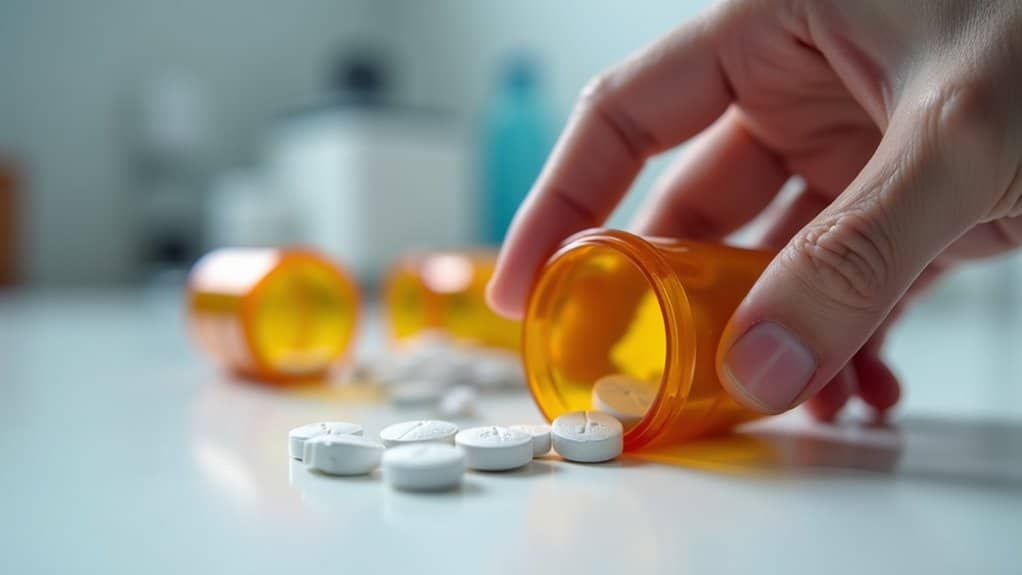
When cocaine withdrawal becomes severe, propranolol offers a clinically significant intervention that addresses both the physiological and psychological dimensions of withdrawal syndrome. By blocking beta-adrenergic receptors, propranolol reduces autonomic arousal and dampens anxiety-driven cravings that typically derail recovery efforts.
Clinical trials demonstrate that 69% of patients with severe withdrawal completed treatment on propranolol versus 29% on placebo. You’ll experience relief from tremors, palpitations, agitation, and mood instability within the early withdrawal period. Extended release formulations maintain steady symptom control, optimizing your engagement with behavioral therapies. Propranolol disrupts memory reconsolidation, weakening the association between environmental cues and cocaine use to further strengthen your recovery foundation. Eligibility for propranolol treatment requires participants to score at least 22 on Initial Cocaine Selective Severity Assessment to ensure appropriate clinical matching.
Propranolol’s safety profile advantages make it particularly suitable for addiction treatment contexts, it’s non-habit-forming and well-tolerated. When combined with cognitive-behavioral counseling, propranolol meaningfully improves your treatment retention and reduces relapse risk by lowering both physiological and psychological triggers. As a prescription medication, propranolol is never administered as a standalone treatment but rather paired with other therapeutic interventions to optimize withdrawal management outcomes.
GABAergic Medications Including Baclofen and Tiagabine
Beyond beta-blockers’ management of acute withdrawal symptoms, GABAergic medications offer a complementary pharmacological approach targeting the neurobiological mechanisms underlying cocaine craving and relapse. Baclofen and tiagabine work by enhancing GABA availability, which reduces dopamine release in reward pathways and diminishes cocaine-induced euphoria. Clinical trials demonstrate moderate effectiveness, particularly when combined with cognitive behavioral therapy. Tiagabine showed dose-dependent reductions in cocaine use among dependent patients, while baclofen exhibits promise for relapse prevention. These agents also demonstrate efficacy in alcohol use disorder management, suggesting broader GABAergic utility. Dual-action medications employing glutamate modulation approach further enhance outcomes by blocking reinstatement mechanisms. Transcranial magnetic stimulation represents an emerging neuromodulation technique that may complement pharmacological interventions for addiction treatment. Although neither drug’s FDA-approved for cocaine addiction, both display excellent tolerability and safety profiles, warranting continued investigation as adjunctive treatment components. Baclofen decreased craving response provoked by cocaine cue exposure in human laboratory settings, supporting its therapeutic potential. Combinations of medications, such as topiramate and mixed amphetamine salts, may be especially promising for treating patients who do not respond to standard monotherapy approaches.
Comparing Efficacy Across Treatment Options
When you’re selecting a medication for your patient with cocaine use disorder, you’ll find that abstinence rates vary considerably across treatment modalities, contingency management achieves the highest odds ratio (OR 2.09, 2.13), while psychostimulants show modest efficacy (OR 1.74, 2.48) and GABAergic agents demonstrate mixed results depending on individual patient factors. Your treatment choice should account for patient population characteristics, as opioid agonist therapies benefit only those with comorbid opioid dependence, whereas contingency management and psychostimulants show broader applicability across diverse cocaine-dependent populations. Understanding these differential response patterns allows you to tailor interventions to your patient’s specific clinical profile rather than applying a one-size-fits-all approach. Notably, contingency management programs have demonstrated sustained effectiveness across sensitivity analyses, establishing them as a particularly reliable intervention option for adults actively using cocaine.
Abstinence Rate Comparisons
Because treatment outcomes vary markedly across interventions, understanding which approaches yield the strongest abstinence rates is essential for clinical decision-making. Contingency management demonstrates the most robust end-of-treatment abstinence rates, outperforming both medication and standard psychotherapy approaches. Among pharmacotherapies, topiramate achieves approximately 59% continuous abstinence versus 26% placebo, notably higher than sustained-release dexamphetamine‘s 30% rate. Standard 90-day rehab programs yield 57% full abstinence at one year, though only 27% across psychotherapy and placebo groups achieve cocaine-free status at treatment completion.
Cognitive behavioral therapy enhancements combined with adjunctive medications show promise for severe cases. Critically, detoxification duration alone doesn’t predict outcomes; rather, achieving ≥21 days continuous abstinence during treatment strongly correlates with sustained long-term recovery and reduced post-treatment relapse rates.
Patient Population Responsiveness
Medication efficacy for cocaine addiction isn’t uniform across patient populations, it’s substantially modulated by comorbid psychiatric conditions, baseline use patterns, and demographic characteristics. Your treatment response depends on several converging factors:
- Comorbid conditions: Dextroamphetamine and anticonvulsants show robust effects in patients with concurrent psychiatric illness, while opioid agonists benefit only those with opioid use disorder.
- Baseline cocaine use: High-frequency users respond more favorably to topiramate and psychostimulants than light users.
- Age-related differences: Psychostimulants and anticonvulsants demonstrate consistent efficacy across adult age groups, though pediatric and geriatric populations remain understudied.
- Demographic variations: Urban, minority-majority samples dominate trials, limiting real-world applicability to rural populations.
Anticonvulsants demonstrate superior response odds compared to antipsychotics and antidepressants across diverse patient subgroups.
Current Limitations and the Path Forward
Despite decades of research, the treatment landscape for cocaine addiction remains constrained by the absence of FDA-approved pharmacotherapies and the modest efficacy of agents that’ve shown promise in clinical trials. You’ll find that barriers to insurance coverage persist without regulatory approval, limiting mainstream adoption. The heterogeneity of cocaine-dependent populations, particularly those with comorbid opioid use or ADHD, complicates your ability to predict treatment response and develop personalized treatment approaches. Moving forward, you need well-powered randomized controlled trials examining emerging therapies like GLP-1 receptor agonists in diverse populations. Combining medication with behavioral interventions deserves greater emphasis in research design. Addressing poor retention rates and clarifying efficacy endpoints will strengthen your evidence base for clinical decision-making.
Frequently Asked Questions
How Long Does Cocaine Addiction Treatment Typically Take to Show Results?
You’ll likely notice initial physical improvements within 1, 4 weeks during early stabilization. However, your full recovery timeline extends much longer. Most treatment programs recommend 28, 90+ days for residential care, with longer durations showing better outcomes. You’ll experience clearer thinking by week 3, 4, but psychological symptoms and cravings can persist 6, 12 months. Your relapse risk remains highest in the first 90 days, making sustained aftercare and therapy essential for lasting results.
What Are the Common Side Effects of Medications Used for Cocaine Addiction?
You’ll encounter various side effects depending on which medication you’re prescribed. Disulfiram carries hepatotoxicity risks requiring liver damage monitoring. Modafinil commonly causes insomnia and agitation. Topiramate produces cognitive impairment and paresthesia. Buprenorphine/naloxone combinations frequently trigger nausea, headaches, and sleep disturbances including vivid dreams. You should report persistent symptoms to your clinician, as side effect management often improves treatment adherence and outcomes. Regular medical supervision helps you tolerate medications effectively during recovery.
Can Medications for Cocaine Addiction Be Combined With Other Substance Abuse Treatments?
Yes, you can combine medications for cocaine addiction with other substance abuse treatments, though you’ll need careful monitoring for medication interactions. When you integrate pharmacotherapy with behavioral therapy approaches like cognitive behavioral therapy or contingency management, you’ll achieve better outcomes. You’re likely to experience higher abstinence rates when combining modafinil with counseling or topiramate with psychosocial support. However, you should work closely with your treatment team to manage potential drug-drug interactions and address any psychiatric comorbidities.
How Do I Know Which Medication Is Right for My Specific Situation?
You’ll need a thorough psychiatric and medical evaluation to determine the appropriate medication for your situation. Your doctor must assess your complete medical history, evaluating for cardiovascular, hepatic, or neurological conditions that’ll affect safety. They’ll also consider comorbid psychiatric conditions, withdrawal severity, and your personal recovery goals. Once identified, determining suitable dosage involves close monitoring through standardized clinical assessments. Multidisciplinary input from addiction specialists guarantees personalized treatment matching your unique needs.
Are There Natural or Non-Medication Alternatives to Treat Cocaine Addiction?
Yes, you’ll find effective non-medication alternatives for cocaine addiction. Behavioral therapy, particularly cognitive-behavioral therapy and contingency management, produces significant abstinence results. You can also benefit from exercise, mindfulness practices, and structured routines that reduce cravings. While herbal supplements are marketed for addiction support, they lack robust clinical evidence. Combining evidence-based behavioral interventions with lifestyle modifications and peer support groups offers you a thorough, scientifically-supported treatment approach.